The complaint sounds simple: my hair is too much. Too heavy in Boiling Springs humidity, too slow to dry, a ponytail that pulls, a shape that turns triangular by midday. So weight comes out at the salon, and sometimes the result is worse: the top puffs, the ends look shredded, and short pieces poke through the surface like static. That outcome is not proof thick hair cannot be thinned. It is proof the wrong method took weight from the wrong place.
Symptom: the triangle
Thick hair cut to one length with no internal shaping stacks all its bulk at the bottom, widest at the ends and flat at the roots. The likely cause is not thickness alone but thickness with nowhere to go, especially on wavy hair that expands as it dries. The fix is shaping that removes bulk from the mid-lengths and lets the top layers move, not simply cutting the whole thing shorter, which just makes a smaller triangle.
Symptom: puff and frizz after thinning
When thinning shears are run repeatedly through the same sections, they leave a mix of very short and full-length hairs. The short ones push outward and dry faster and frizzier than the long ones, creating a halo that was not there before the cut. This is the most common thick-hair regret, and it comes from texturizing too close to the surface and too near the ends. Weight removal belongs inside the haircut, in the interior, where shorter support hairs stay hidden under a smooth top layer.
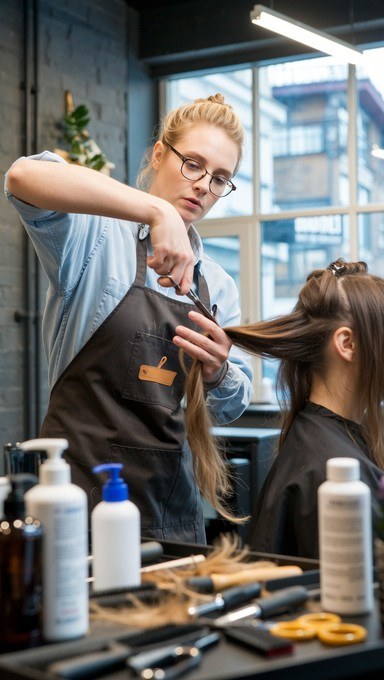
Work the problem in order
- Name where the weight bothers you. Bulk at the back, heaviness at the ends, and a hot, heavy nape are different problems with different fixes. Point at the spot in the mirror.
- Ask what tool will be used, and where. Razors, thinning shears, point cutting, and slide cutting all remove weight differently. Interior work preserves the surface; surface work shows.
- Check the ends before more comes off. If ends already look wispy or see-through, the haircut has enough removed. More texturizing trades a weight problem for a thin-ends problem.
- Consider an undercut for nape bulk. Clipping or shortening the hidden underside at the neck removes real weight and heat without changing how the hair looks down.
- Judge the cut dry and styled normally. Thick wavy hair cut wet can spring up and expand. Ask to see it dried the way you wear it before deciding it needs more out.
- Fix grow-out with shape trims, not re-thinning. As texturized sections grow, short pieces change the balance. A shape trim restores order; thinning again compounds the frizz layer.
What thinning should and should not mean
Done well, thinning means selective bulk removal: collapsing excess width in specific zones while keeping the outline and the ends intact. A good thick-hair cut still has substantial ends you can see and feel. Done badly, thinning means running shears through everything until the haircut has no structure left, at which point every section does its own thing and styling takes longer than it did with the weight in.
Stylists at Hair Razors also weigh hair type. Coarse, straight thick hair tolerates more aggressive interior work. Thick but fine-textured hair, a common and confusing combination, needs restraint, because each strand is fragile even though there are many of them. Thick curly hair needs weight removed in a way that respects curl clumps, or the shape turns to fuzz.
At home between cuts
Dry thick hair in sections instead of blasting the whole head, which leaves the interior damp and puffy for hours. Use enough product to coat all of it, since a pea-sized amount disappears into thick hair, and apply in sections too. Sleep with it loosely braided or up in a soft tie to cut morning bulk. And keep the trim schedule: thick hair hides split ends longer, but once the ends go, the whole shape roughens at once.
One more check worth doing at home: run your hands through the dried hair a week after the cut, not just in the salon light. If hidden short pieces have started pushing out, or one side collapses while the other holds, tell the salon exactly that at the next visit. Good records of how a cut grows out are how a stylist tunes the next one, and thick hair, more than any other type, is a long-term shaping project rather than a one-visit fix.
Common questions
Why did my hair get frizzier after it was thinned?
Thinning shears used near the surface leave short hairs that dry faster and push out. Interior texturizing by a stylist who can show you where they worked avoids most of it.
Is an undercut a good idea for thick hair?
Often yes for nape bulk and summer heat, since the top layer covers it completely when worn down. It does commit you to upkeep as it grows out.
How often does thick hair need cutting?
On a normal trim schedule, with shape checks as it grows. Thick hair that goes too long between cuts loses its internal shape and the bulk creeps back all at once.
Photos in this guide are representative stock images.
← All guides from Hair Razors← Back to Hair Razors